Most people use the words "clean" and "sanitized" interchangeably, and honestly it makes sense. If something looks clean, it feels clean. But here is the thing: a surface can look spotless and still be covered in bacteria and viruses. And on the flip side, a surface can be thoroughly disinfected and still have visible grime on it. These are two different problems, and solving one does not automatically solve the other.
In today's blog, we're going to cover the real difference between cleaning for dirt and cleaning for germs, why both matter, and what products and techniques actually get the job done for each one.
The Difference Between Cleaning, Sanitizing, and Disinfecting
Before we get into products and techniques, it helps to understand what these three words actually mean, because they are not the same thing.
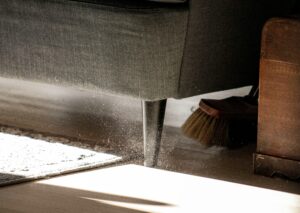
Cleaning means physically removing dirt, dust, debris, grease, and other visible material from a surface. This is what happens when you wipe down a counter or mop a floor. You are not necessarily killing anything. You are removing the visible stuff and reducing the overall number of particles on the surface.
Sanitizing reduces the number of bacteria on a surface to a level considered safe by public health standards. It does not eliminate everything, but it gets the count low enough to significantly reduce risk.
Disinfecting goes further, using chemicals to destroy or inactivate viruses, bacteria, and other pathogens on a surface. A disinfectant does not necessarily clean visible dirt, but it does kill what you cannot see.
Here is the key takeaway: you typically need to clean before you disinfect for either step to work properly. Disinfectants applied to a dirty surface get neutralized by the organic material (grease, food residue, dust) before they can do their job. Cleaning first removes that barrier and lets the disinfectant actually reach the surface.
Cleaning for Dirt: What That Looks Like
When you are cleaning for dirt, your goal is physical removal. You are lifting, wiping, sweeping, scrubbing, or vacuuming material off of a surface and getting it out of the space.
The most effective tools here are mechanical ones: microfiber cloths that trap particles rather than pushing them around, good vacuum equipment with strong suction, mops that actually pick up debris, and the physical motion of scrubbing. Soap and water are the classic combination here, and they work because soap is a surfactant that breaks the bond between dirt and the surface, making it easy to wipe or rinse away.
For everyday household cleaning for dirt, warm water and a few drops of dish soap handle most surfaces well. Microfiber cloths are significantly better than paper towels or cotton rags for this purpose because they physically grab particles at a microscopic level rather than just moving them around. If you are dealing with grease or buildup, degreasers and baking soda pastes are excellent options that work through the same principle of breaking down bonds between grime and the surface underneath.
The goal when cleaning for dirt is simple: the surface should look and feel clean when you are done. No residue, no streaks, no visible debris.
Cleaning for Germs: What That Looks Like
Cleaning for germs is a different objective and requires different products. Here your goal is killing or inactivating microorganisms that you cannot see and that a regular wipe-down will not remove.
EPA-registered disinfectants are the standard for this category. These are products that have been tested and proven to kill specific pathogens, including the viruses responsible for cold and flu. Common household examples include Lysol disinfecting spray, Clorox disinfecting wipes, and bleach solutions. The most important thing most people do not know about these products is the dwell time: the surface needs to stay visibly wet for the amount of time listed on the label, usually somewhere between 30 seconds and 4 minutes depending on the product, for the disinfectant to actually do its job. Spraying and immediately wiping does almost nothing.
For a more natural approach to germ reduction, hydrogen peroxide at a 3% concentration (standard pharmacy variety) is genuinely effective against a range of bacteria and viruses. Spray it on, let it sit for a few minutes, and wipe clean. It breaks down into water and oxygen after use, leaves no harmful residue, and has no harsh fumes. It is one of the most underrated natural cleaning products available.
White vinegar is commonly cited as a natural disinfectant, but it is worth being honest here: vinegar is a good everyday cleaner and deodorizer, but it does not have the same disinfecting power as hydrogen peroxide or an EPA-registered product. It reduces surface bacteria and works well for routine maintenance, but for high-touch surfaces during cold and flu season or after someone in the house has been sick, a proper disinfectant is the better call.
Tea tree oil diluted in water has documented antimicrobial properties and can be added to homemade cleaning solutions for a boost, but like vinegar, it is better suited to everyday maintenance than true disinfection.
For The Road
Taking time to understand the difference between cleaning for dirt and cleaning for germs can make all the difference in the world for your home and your family's health. Contact us if you or someone you know may be in need of a residential or commercial cleaning service like ours. We can't wait to hear from you. Give us a call or email us here. Have fun and stay safe out there!